
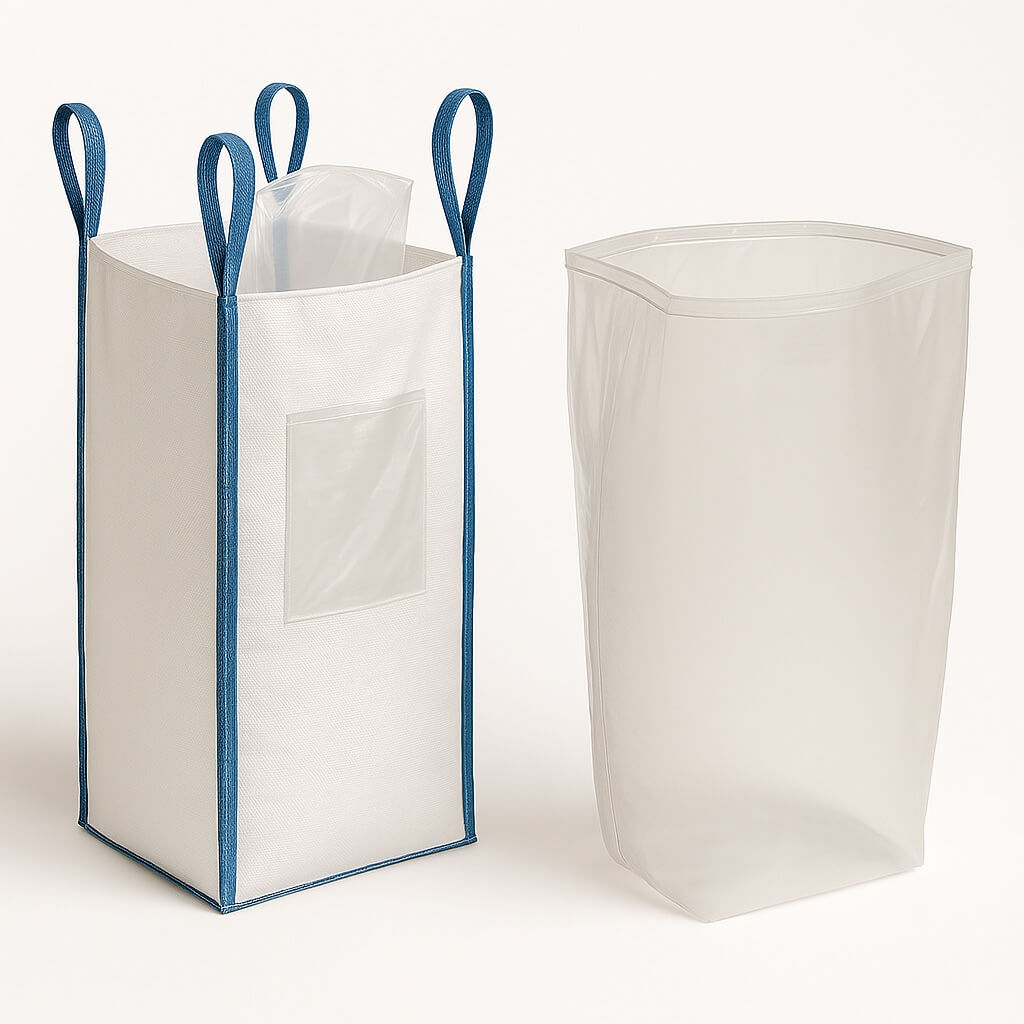
Description
FIBC big bag liners are inner bags made from polyethylene (PE) film that sit inside the woven polypropylene shell of an FIBC bulk bag. They create a sealed barrier between the product and the PP fabric, protecting contents from moisture ingress, external contamination, and fine particle loss through the weave of the fabric.
NovoPacks supplies PE liners for FIBC big bags in food-grade and standard specifications, in loose-fit and form-fit styles, with or without fill and discharge spouts, to match any bag dimension and filling system. We also supply EVOH co-extruded liners for oxygen-sensitive products and aluminium composite liners for maximum barrier performance.
When an FIBC Liner Is Required
Not every FIBC application needs a liner. For coarse, dry, non-hygroscopic materials like construction aggregate or plastic pellets, the PP fabric alone is sufficient. But for the following applications, a liner is essential:
Fine powders such as flour, starch, titanium dioxide, and calcium carbonate can leak through the gaps in the PP weave, causing product loss and dust contamination. Hygroscopic materials including sugar, milk powder, fertilizer salts, and urea absorb atmospheric moisture rapidly, and a sealed PE liner prevents this. Food ingredients must comply with EU Regulation 10/2011 on plastic food contact materials, and the liner is the food-contact surface. Pharmaceutical and nutraceutical bulk loads require contamination control between the product and the outer bag. Aroma-sensitive products like coffee, cocoa, and spices need a barrier against oxygen and odour transfer.
Loose-Fit vs Form-Fit Liners
A loose-fit liner is a tube of PE film supplied inside the bag and tied or heat-sealed at the top after filling. It is the most economical option, easy to fit without special equipment, and suitable for most dry powder and granulate applications. The loose tube liner is the most common FIBC liner in use across European industry.
A form-fit liner is manufactured to the exact internal dimensions of the bag, fitting snugly against the inner walls. Form-fit liners maximise usable fill volume, prevent the liner bunching at the discharge spout during emptying, and provide a cleaner and more complete product discharge. They are preferred for food, pharma, and high-value material applications where yield and cleanliness matter.
Food Grade and Specialist Barrier Liners
Our food-grade PE liners comply with EU Regulation 10/2011 on plastic materials intended for food contact. They are manufactured from compliant food-grade resin and can be supplied with material compliance documentation for your traceability records.
For products sensitive to oxygen and aroma loss, EVOH (ethylene vinyl alcohol) co-extruded liners incorporate an oxygen barrier layer within the PE structure. This avoids the need for a separate aluminium foil liner while providing significantly better oxygen barrier performance than standard PE alone. EVOH liners are used for coffee, cocoa, spices, and certain pharmaceutical ingredients where oxidation affects quality and shelf life.
For the highest level of moisture and gas barrier performance, laminated aluminium composite liners are available. These are specified for extreme sensitivity applications where even EVOH barrier performance is insufficient.
Fill and Discharge Spout Options
Liners can be supplied plain (open top), with a fill spout sized to match your bag and filling nozzle, with a neck tie closure at the top, or with a discharge spout at the bottom that aligns with the bag discharge spout. Spout diameter and length are specified to your filling equipment dimensions.
Frequently Asked Questions
What size PE liner do I need for my FIBC big bag?
Liner dimensions are specified to match your bag internal dimensions, with allowance for the fill spout or neck. We manufacture to your bag specification — share your bag dimensions (length, width, height, and spout size if applicable) and we will size the liner correctly for a good fit.
What thickness PE liner is right for my product?
Standard FIBC liners range from 60 to 150 microns. For fine, light powders with low abrasion (flour, starch, sugar), 80 to 100 microns is typical. For heavier, abrasive materials or where the liner will be handled multiple times before filling, 120 to 150 microns gives better puncture resistance and durability.
Does my FIBC liner need to be food grade?
If the product inside the bag is a food ingredient or will directly contact food, the liner must comply with EU Regulation 10/2011 on plastic food contact materials. Our food-grade PE liners are manufactured from compliant resin and supplied with the relevant material declaration. The outer FIBC bag should also be food-grade PP for a complete food-contact compliant packaging solution.
Can I order liners separately for existing bags?
Yes. Liners can be ordered independently of bags. Provide your FIBC bag dimensions and we will supply loose-fit liners that fit your existing stock. For form-fit liners, the exact internal bag dimensions need to be confirmed before production to ensure a proper fit.
What is the difference between a PE liner and an EVOH liner?
A standard PE liner provides a moisture barrier and contamination barrier but offers limited protection against oxygen transmission. An EVOH liner incorporates an ethylene vinyl alcohol co-extrusion layer within the PE film, which dramatically reduces oxygen transmission rate. EVOH liners are used when oxidation, aroma loss, or flavour transfer is a concern for the product — common applications include coffee, cocoa, spices, and certain pharma ingredients.