
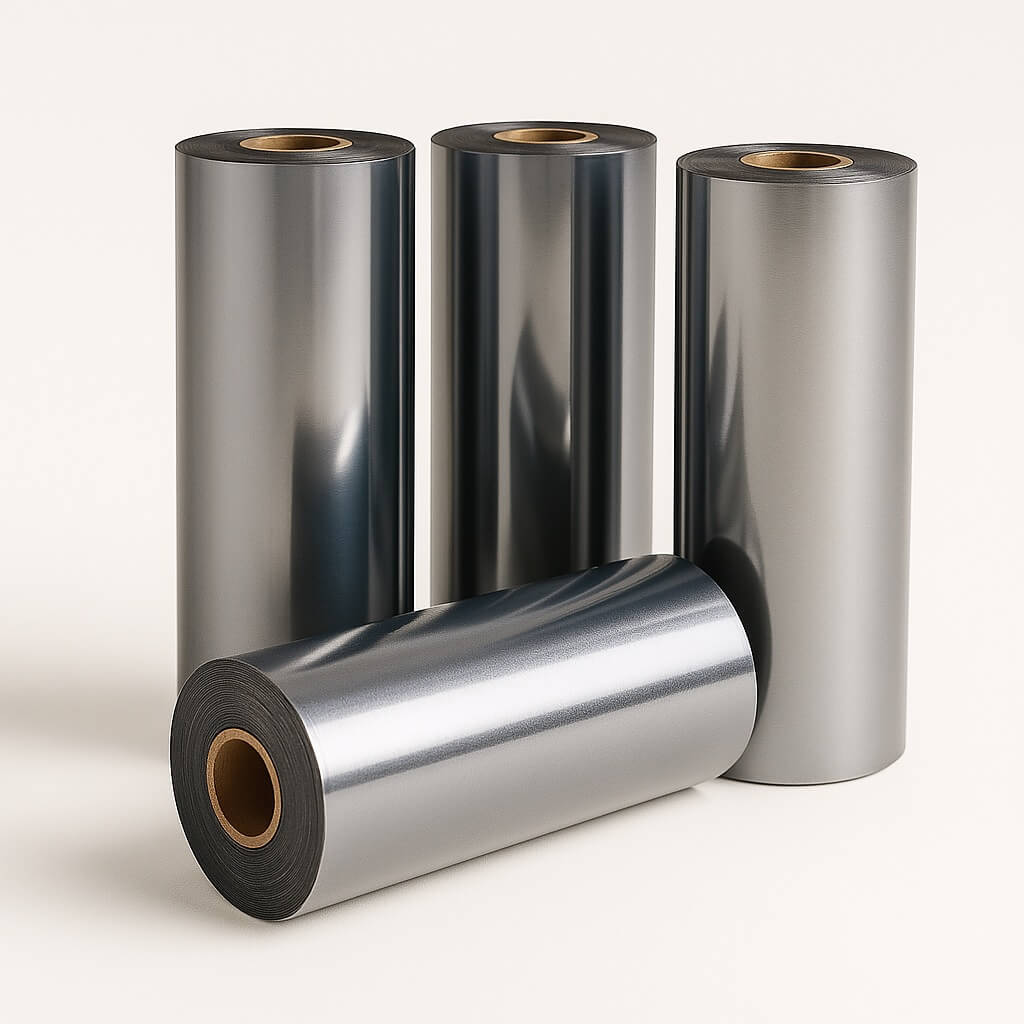
Description
Non-sealable metallised BOPP film is the standard workhorse metallized film used by flexible packaging converters across Europe as a lamination substrate and decorative outer ply in multi-layer flexible packaging structures. Without a heat-sealable coating, the film is engineered specifically for adhesive lamination processes, where it is bonded to a sealable inner film to create a complete packaging structure with both the metallic appearance of the outer layer and the reliable heat-seal performance of the inner one.
The aluminium metallization is applied by vacuum deposition to a transparent BOPP base, producing a consistent silver mirror finish across the full web width. The optical density of the metallization layer is maintained to tight tolerances during production, ensuring consistent barrier performance and metallic appearance across the entire roll and between production batches – both of which are critical requirements for brand owners and converters supplying major retail and food service customers.
Barrier Properties and Technical Specifications
The key functional contribution of metallized BOPP film in a laminate structure is its barrier performance. Oxygen transmission rate (OTR) and moisture vapour transmission rate (MVTR) are reduced by an order of magnitude compared to unmetallized BOPP of the same gauge. This barrier improvement extends the shelf life of sensitive food products including coffee, tea, snack foods, baked goods, and dried ingredients, without the weight and cost of full aluminium foil.
The film is compatible with both solventless and solvent-based adhesive lamination systems. Adhesion to the metallized surface is a key technical parameter – the metallization layer must be pretreated to ensure adequate peel strength in the finished laminate structure. NovoPacks supplies film with adhesion-optimised metallization surfaces suited to standard European lamination adhesive systems.
Frequently Asked Questions
Why is non-sealable metallised BOPP used instead of sealable metallised film?
In multi-layer laminated flexible packaging, different layers can be optimised for different functions. The outer metallized BOPP provides the decorative, printed, and barrier contribution, while the inner sealable film (typically polyethylene, CPP, or LLDPE) provides the heat seal. This split-function approach often produces better overall package performance than trying to achieve all functions in a single metallized sealable film. It also allows converters to vary the inner sealable layer for different food products without changing the outer metallized substrate.
What is the optical density of the metallization layer and why does it matter?
Optical density (OD) is a measure of how opaque the aluminium layer is to transmitted light. Standard metallized BOPP for flexible packaging typically has an OD between 2.5 and 3.5. Higher optical density corresponds to a thicker aluminium layer, which gives better barrier performance and a more mirror-like surface. Lower OD may be used where a semi-transparent metallic effect is the design intent. NovoPacks can supply film to specific OD targets on request.
Can non-sealable metallised BOPP film be printed?
Yes. The film can be reverse-printed using gravure or flexographic inks before lamination, which protects the printed graphics from abrasion in the finished package. It can also be surface-printed on the metallized side, though this is less common for food packaging as the metallic surface print is not protected against abrasion in use. Reverse printing between the metallized film and the inner sealable laminate web is the most common and highest-quality approach.
Is metallised BOPP film suitable for microwave packaging?
Standard metallised BOPP is not suitable for microwave applications because metal in a microwave causes arcing. For microwave packaging applications, non-metallized films must be used. If a reflective or barrier effect is required for a product that will be microwaved, alternative non-metallic barrier coatings such as silicon oxide (SiOx) or aluminium oxide (AlOx) transparent barrier films can be considered – contact NovoPacks for guidance on available alternatives.
What roll dimensions are available for non-sealable metallised BOPP film?
Master roll widths typically range from 1000mm to 3000mm, and the film is slit to converter-specific widths as required. Standard thicknesses range from 12 to 25 microns. Thinner gauges minimise material weight and cost in the finished laminate, while thicker gauges add stiffness and improve machinability on high-speed laminating lines. Contact NovoPacks for current availability and minimum order quantities in your required specification.