
Description
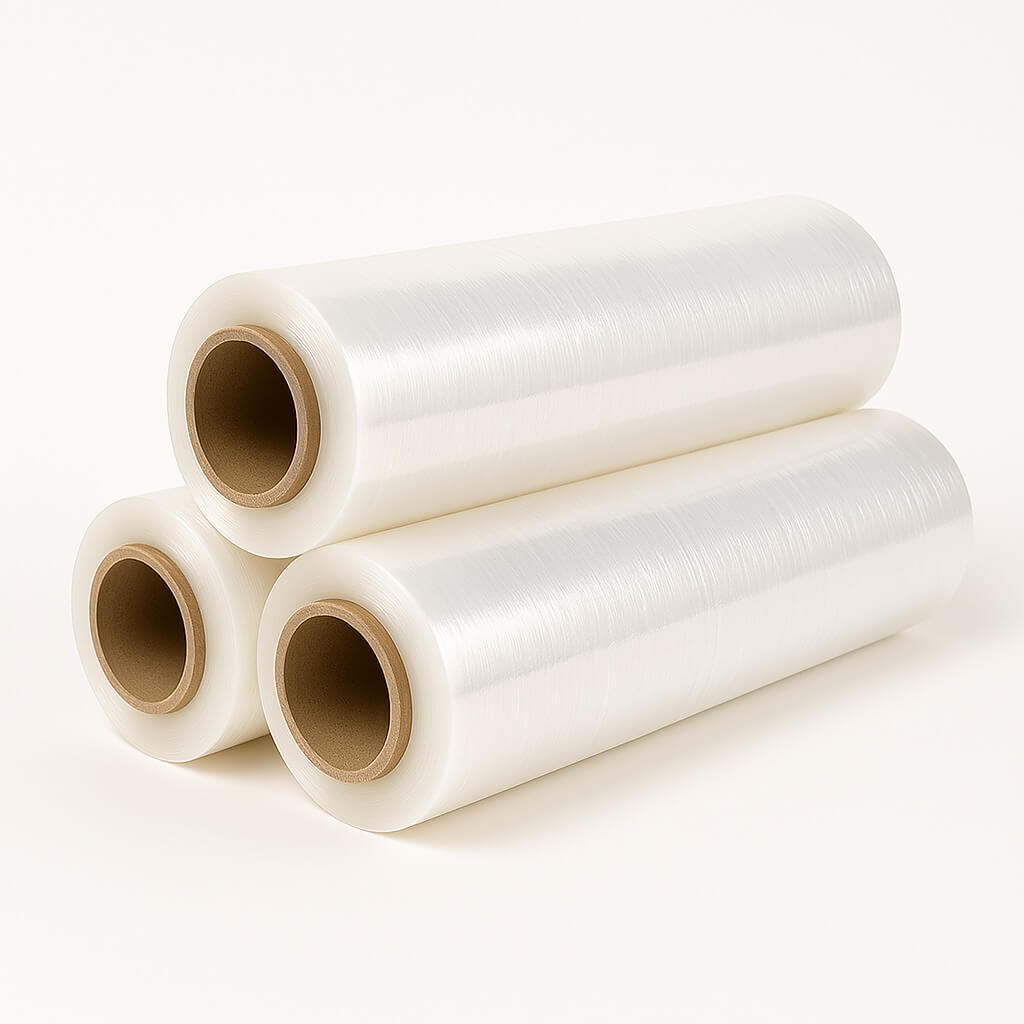
Hand stretch film – also called manual stretch film or hand-grade stretch film – is the practical, no-equipment-needed solution for securing pallets and loads in warehouses, depots, and retail stockrooms where a machine pallet wrapper is not available or not practical. The film is applied by walking around the pallet while unrolling and stretching the film by hand, wrapping load layers tightly to secure the goods for transport or storage.
NovoPacks supplies hand stretch film in cast LLDPE formulations that balance easy hand application with strong load containment. The film stretches consistently without tearing, clings firmly to itself once wrapped, and maintains tension across the load during transit. Standard and pre-stretched (pre-stretched requires less physical effort during application) grades are both available, as well as extended core versions for operators who prefer to work without a dispenser handle.
Choosing the Right Gauge for Your Load
Hand stretch film thickness (measured in microns) is the key variable for load type. Standard pallets of boxed goods for domestic distribution are typically wrapped with 17 to 20 micron film. Heavier or more irregular loads, or those going into export or long-distance transport, benefit from 23 to 25 micron film for increased puncture and tear resistance. Pre-stretched film uses significantly less material per pallet wrap than standard film because the stretching energy is applied during manufacture rather than during application – this reduces material cost and operator fatigue simultaneously.
All grades are supplied in 500mm width rolls on hand-sized cores. Both transparent and coloured grades (black, blue, red) are available for load identification and security applications.
Frequently Asked Questions
What is the difference between hand stretch film and machine stretch film?
Hand stretch film is designed for manual application and is supplied on smaller cores with a width of around 500mm. It stretches at the relatively low forces that a person can apply by hand and is easier to tear at the end of a wrap cycle. Machine stretch film is formulated to stretch at the much higher forces applied by automatic and semi-automatic pallet wrappers, typically at elongation rates of 150 to 300 percent. Using machine film by hand risks hand and wrist injury, and using hand film on a machine may result in film breakage or poor load containment.
How many wraps of hand stretch film does a pallet need?
A standard guidance is four to six wraps at the base of the pallet (overlapping the pallet board to prevent the load from sliding off), followed by a continuous spiral up the load and four to six wraps at the top. The exact number depends on load weight, box uniformity, and transport distance. Heavier or longer-haul loads benefit from additional passes. Your logistics or warehouse manager can advise on the correct specification for your specific load types.
What is pre-stretched hand film and is it worth using?
Pre-stretched film is stretched to around 70 to 80 percent of its maximum elongation during manufacture and then wound onto the roll. During application, the operator applies very little additional force – the film simply needs to be kept under light tension as it is walked around the pallet. This reduces operator fatigue significantly for high-volume wrapping, and because the film is already thin and lightweight, less material is consumed per pallet. For businesses wrapping more than 10 to 20 pallets per day by hand, pre-stretched film typically delivers a lower cost per pallet than standard hand film.
Can hand stretch film be used for bundling rather than pallet wrapping?
Yes. Hand stretch film is widely used for bundling long items such as pipes, timber, profiles, and metal sections, and for wrapping individual irregularly shaped products that need protection during transit. Narrower rolls (100mm to 300mm) are available for more precise bundling applications where a full 500mm web would be excessive.
What storage conditions does stretch film require?
Stretch film should be stored indoors, away from direct sunlight and heat sources, at temperatures between 5 and 35 degrees Celsius. UV exposure degrades the polymer and reduces the film performance over time. Rolls should be stored upright or on their cores – not flat – to prevent core deformation. Under correct storage conditions, standard stretch film has a usable life of 18 to 24 months from the date of manufacture.