
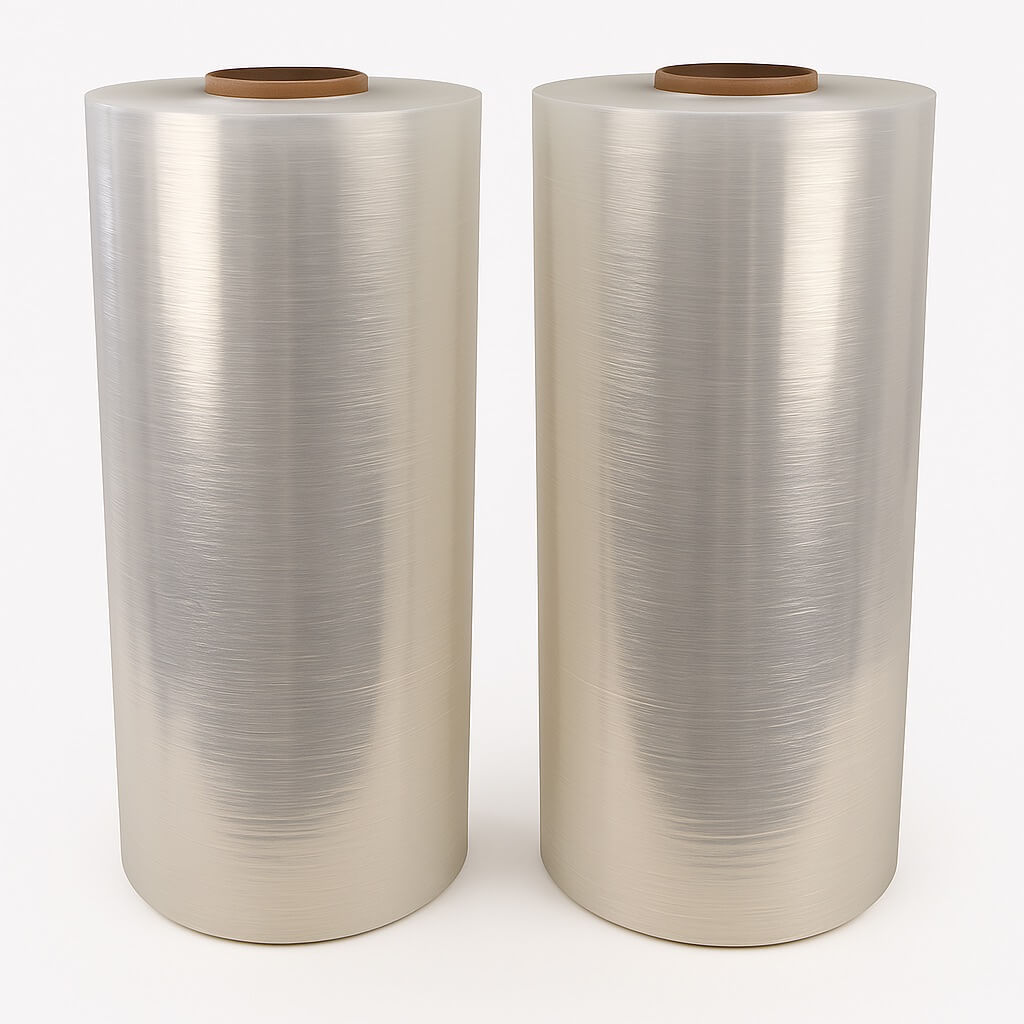
Description
Nano-layer machine stretch film represents the current leading edge of stretch film technology for automatic pallet wrapping. Rather than being produced as a single or three-layer film, nano-layer stretch film is co-extruded with dozens to hundreds of extremely thin individual polymer layers, each contributing specific mechanical properties to the overall film structure. The result is a film that delivers significantly higher puncture resistance, elongation at break, and load containment force per micron of thickness compared to conventional cast stretch film of the same gauge.
The Power Series nano-layer stretch film from NovoPacks is targeted at the most demanding pallet wrapping applications in European industry – heavy loads, irregular shapes, sharp-cornered products, high-speed wrapping lines, and operations where film breakage is costly in both downtime and re-wrapping labour. For businesses already running modern high-speed pallet wrappers, switching to nano-layer film typically allows a gauge step-down – running a thinner film that performs equal to or better than the standard film it replaces, with direct material and cost savings.
Technical Advantages of Nano-Layer Construction
In conventional stretch film, puncture resistance and elongation are partly in tension with each other – a film formulated for very high elongation may sacrifice some puncture resistance. Nano-layer co-extrusion allows the two properties to be optimised independently by varying the resin selection and thickness of different internal layers. The very thin individual layers also create more polymer chain entanglement across the layer interfaces, which distributes stress more evenly when the film is punctured or stretched to extremes.
From a sustainability perspective, nano-layer film allows the same load containment performance to be achieved with a meaningfully thinner and lighter film. Reducing from 23 to 17 microns while maintaining performance cuts film weight per pallet by around 26 percent, which reduces material cost, carbon footprint per pallet wrapped, and the volume of plastic film entering the waste stream.
Frequently Asked Questions
What is nano-layer stretch film and how is it different from standard cast stretch film?
Standard cast stretch film is typically produced with one, three, or five layers. Nano-layer stretch film is co-extruded with a much larger number of extremely thin layers – sometimes over 100. This multi-layer structure distributes mechanical forces more evenly through the film cross-section, resulting in higher puncture resistance, better tear propagation resistance, and more consistent elongation properties compared to conventional film of the same overall thickness.
Can nano-layer stretch film run on my existing pallet wrapper?
Yes. Nano-layer machine stretch film is physically identical to standard cast stretch film in terms of core dimensions, roll width, and basic handling. It runs on the same turntable, rotary arm, and ring wrappers used for standard film. The mechanical compatibility is the same – what changes is that the wrap programme may need adjustment because the superior containment performance of nano-layer film often means fewer revolutions are needed per pallet to achieve the target containment force.
What gauge reduction is realistic when switching to nano-layer film?
The achievable gauge reduction depends on the load type and the containment force requirement. In practice, many European distribution and manufacturing operations can step down one to two gauge increments when switching to nano-layer film – for example, from 23 micron to 17 micron – and achieve equal or better load containment with less film. The exact achievable reduction should be validated through a trial on your specific loads before committing to a full changeover.
Is nano-layer stretch film more expensive per kilogram than standard film?
Nano-layer film typically carries a higher price per kilogram than standard cast stretch film due to the more complex extrusion process. However, because less film is used per pallet at equivalent or superior performance, the total cost per pallet wrapped is often lower than with standard film. The full cost comparison should account for film weight per pallet, not just film price per kilogram.
What types of loads benefit most from nano-layer stretch film?
The greatest benefits are seen with loads that place high stress on the film: heavy stacked loads, products with sharp corners or protruding features (such as timber, engineering components, or appliances), mixed loads with irregular shapes, and loads that will travel long distances with multiple handling points. For light, uniform pallet loads being wrapped for short-distance transport, standard cast stretch film may be sufficient and the cost advantage of nano-layer film will be smaller.